
Category: Uncategorized
Triptychs and Sustainability: Experiments with Photoshop and Final Cut
Today I briefly experimented with the use of Photoshop and Final Cut Pro in preparation for creating my triptych later in the week. I wanted to be sure I knew roughly how to use the different aspects of the programmes before having to actually edit the piece. I experimented briefly with removing the shape of the silhouette from an image on Photoshop, initially having the problem that the silhouette was not transparent when layered over another image. I later realised that I need to save the file as a png. rather than jpeg. in order to achieve what I had hoped. I then quickly looked at the basic features of Final Cut, particularly focusing on how to arrange multiple videos and image and layering. I found this fairly easy to do and think I will hopefully be able to achieve the desired look.
Triptychs and Sustainability: ‘Slow Magic’ Photograph and Project development

The image above is a marketing image for a band called ‘Slow Magic’ (I am unsure of who the photographer of the image is). I came across this image whilst looking at a blog this week and quickly decided that I liked it and started to consider how I could link it into my own work in some way. I considered the fact that the image shows difference between the quite gloomy and urban setting on the outer of the photograph and the bright landscape on the inner; I feel like this is suggestive of the models desire to be somewhere else. I felt this would work well with establishing the effect that people have on the world – in terms of sustainability, showing how the small things we do can alter and contribute to our ever changing world. This type of comparison would work well, to show the good or bad effects that we can cause in our everyday lives.
Linking with the already established theme of transport and comparison I am going to try and utilise this style in my triptych. As I liked the idea of comparing people who are and are not sustainable, I am going to exhibit the different types of transport that can be used and inside the silhouette of the particular mode of transport display the positive or negative effect it has on our world; either natural or unnatural. I am going to stick with the implementation of two people who are sustainable on the outer of the image, and a person who is unsustainable in the centre; thus allowing easy comparison and giving the impression that there a lot of people already making the difference. The modes of transport I am going to focus on are cycling (being sustainable), walking (again being sustainable) and driving (being unsustainable). Within the silhouettes of these particular modes of transport I am going to display something that is natural within the sustainable modes and something which appears unnatural within the unsustainable mode. I have an idea to incorporate the sea to display nature and beauty and the attractiveness of the planet we live on, and then some kind of smoke or steam to represent the gases that are slowly contributing to the distraction of our planet.
Triptychs and Sustainability: Project Development
After discussing my idea with a tutor I have decided not to proceed with the idea I had to compare people who are and are not sustainable. We decided that the idea was too literal and may have been seen as quite unrealistic, in the sense that bad things would happen purely because one person wasn’t sustainability. The idea was also very in-depth and would have taken a long time to produce in the short time we have, I feel that if the piece was done in this rushed time period it would not have been effective enough and created a cheap look that would not persuade and advertise as intended. We did make the decision that the theme of how everyday people can contribute to making the planet more sustainable and using the topics identified previously in a new piece. I would like to still look at comparison as I feel this works well with the triptych format.
Triptychs and Sustainability: ‘How to be sustainable’ articles
After considering the idea for my triptych of comparing lives of people who are sustainable and who are not I decided to research methods of being sustainable in everyday life. As lifestyle is one of the biggest contributors to the impact we have on the environment and the changes that are occurring/going to occur I felt it appropriate to look at lifestyle particularly in this project as it would allow to audience to relate to the piece to their own lives and the simple changes they can make. I came across a couple of articles related to tips about how to lead a sustainable lifestyle, I tried to find articles directly describing the day of sustainable person but unfortunately could not find anything this direct. The articles I found are listed below.
http://green-changemakers.blogspot.co.uk/2009/07/10-sustainable-lifestyle-tips.html
http://relache.hubpages.com/hub/10-Tips-for-Sustainable-Living
Within these articles I tried to pick out the most substantial points that they had in common and tried to think whether the point would work effectively within a short video. I also thought how the points could be reverted to create the opposite of being sustainable and exaggerate a point about sustainability.
The main points I came across that would work in the video are below, I have also included my own previous knowledge of how to live sustainability:

–Travel: Cycling, using public transport or walking instead of driving a car or motorbike. I feel I could do one person in the triptych riding a bike, one walking and the unsustainable person in the centre driving a car. To make the point that walking and cycling could be effective to the persons own life as well as the world I considered that the person driving could get stuck in traffic (as is common) and then be later for the meeting with the two people who are sustainable. I could also link this to health and how cycling/walking would improve fitness etc.

–Recycling: Recycling is mentioned in the articles above but is something that has been heavily encouraged and largely spoken about in relation to sustainability in recent years. I think that this action would work well in my piece, highlighting that the two sustainable people recycle where as the third does not. To exaggerate the need to recycle and how it is not a hassle etc I considered that the unsustainable persons general rubbish bag could be so full when throwing something away that he has to take the bag out, ripping on the way due to the heavy content – thus adding to the annoyance of the persons day.

–Electricity: One of the articles voiced the need to save power and electricity and reduce our use of it. This has also been something that has been spoken about in the media in recent years, largely with the promotion of energy saving lightbulbs, energy usage monitors etc. I feel that this theme would work effectively within my piece, exaggerating the point slightly to make it effective. The two people who are sustainable could turn everything off and remove plugs of everything etc, not leaving things on stand by and so on. However the person whom is not sustainable would leave everything on, even the television or radio etc, leaving in such a rush they are left on all day. To make the need to be energy efficient seem personal highlight on the payment of energy/gas bills in the film could voice that it is a lot cheaper to preserve power.
These would be the main focuses of the video, however I would also look at more minimal features just to tie the video together:
-Use of roll ons V aerosols
-Highlight the need to conserve water through shots of Water storage containers, opposing with running taps etc for the non sustainable
-Use of showers instead of baths, backing up the point on water
-Use of reusable items such as bags etc instead of plastic
-Consumerism, unsustainable could have a delivery of unneeded goods.
I am going to discuss these ideas with a tutor in order to gain opinion and decide whether or not to progress with these ideas and expand on them etc.
Triptychs and Sustainability: Linking the two
Since being given the brief for this project I have been trying to decide how I can link the theme of sustainability to a triptych. Initially I found this very difficult to do, and didn’t think they worked effectively together as concepts in the slightest. However, when recapping my research and knowledge of triptychs, I noticed the way that triptychs offer the chance for an audience to compare. They compare the content of the image and what is different, and then make assumptions about the surrounding detail.

The triptych above is a perfect example of how they can be comparative. As an audience we look at the three images individually but then also look at them an entire piece, allowing us to compare them without even realising. We look at how the model has been effected differently in each of the images, wondering what has happened to cause him to feel each emotion individually. However, when looking at the triptych as a whole we could consider that one event/trauma/illness could be causing this, suggesting he is a trapped or lost sole. Similarly in the videos below we compare the different things the individual has done on his travels, focusing particularly on each subject matter – Eat, Live, Learn – and then his travels as a whole and how each of the subjects linked together made a truly extraordinary experience.
In relation to linking this comparative nature of triptychs my own project I have considered how I could make a comparison between people who are sustainable and people who are not. I feel I could use the 3 individual pieces, probably video, to show how two people are sustainable and show the life they live and then one person who is not. By doing so I could create a comparison that voices the point that by being sustainable you can also benefit your own life in small ways. For example, riding a bike or walking to avoid traffic. I want to look at the small things people do at home etc to be sustainable and make a difference in small ways in their everyday lives. This way I could display opposites.
Triptychs and Sustainability: Recap on Research
Triptychs are generally a set of three artistic pieces that are somewhat related and intended to be viewed together in order to create a single piece. They historically were related to religion and often seen in churches, usually displayed on some sort of panels that were generally hinged together – this set of three in relation to christianity was often thought to be relative to the three ‘Father, Son and the Holy Spirit’. Traditionally the centre image of a triptych was rather larger than the images to the sides, this attribute is often still visible in modern triptychs. Modern depictions are often also a single image which has been split into 3 to create a slightly more dramatic effect – like the one shown below.

Not all modern triptychs use this method of splitting a single image, they are still often 3 separate images that have some variety of common factor or focus. Modern triptychs do not always consist of just the use of photographs, some are created with film, graphics, audio and still painting/drawing. Video triptychs are sometimes linked in the traditional method, side by side, however they can also be just 3 individual videos that are linked – like a series.

Sustainability is based on being able to maintain a certain rate or level of something, for example the earths resources that we use to power our lives. To live a sustainable life is to preserve what we use in the most effective way possible, saving resources and effectively saving the earth and the human race. An example of being sustainable would be to use a reusable fabric bag for lunch rather than a paper or plastic one, or just a simple task like recycling household food packaging etc. Sustainability ties into design because it can establish how easily things can be changed and make an individual more of a sustainable person. Advertisement or viral marketing ads are often created with the theme of sustainability as it can help the audience to want to make a difference to the world etc. Designers in general are trying to design more sustainable things (products, buildings – as in the image above- etc) in order to add another reason for the consumer to buy it. It is now becoming more fashionable and desirable to be sustainable – which is definitely needed.
Triptychs and Sustainability: The Brief
As part of the project, Principles of Digital Media, we were briefed to expand on our initial research of Triptychs and Sustainability and produce a piece which incorporated the two themes. I initially tried to think about how I could create a triptych piece that incorporated the idea of sustainability in a comprehendible and fitting manner. I am also trying to think about how I can create this piece in a way which utilises and develops skills in a number of the adobe editing suites, as explained is an objective in the brief. In order to continue I am going to once again research into the basics of Triptychs and Sustainability and how they could be possibly linked, trying to find artists and examples of work that can inspire my own piece.
Augmented Reality and After Effects
Wikipedia defines Augmented reality, also know as AR, as “a live, direct or indirect, view of a physical, real-world environment whose elements are augmented by computer-generated sensory input such as sound, video, graphics or GPS data.”. This basically means that AR is the real world with something unreal laid over the top, for example a photograph of people with their individuals names placed on the image to suggest who is who etc. Augmented reality is mainly coming into use through use of smart phones and tablet computers in the modern age, largely being used for map type applications or to create special effects or object in the real world without them actually being there.
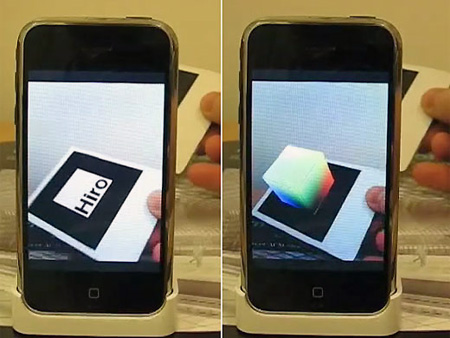

The first of the images above creates the effect of an object sat on top a piece of paper which actually has nothing on it. This form of Augmented Reality uses a marker with a specific code/shape/word on top suggest where a particular object should sit in the false reality. When looking through the smartphone camera, using a special application, the app and camera spot the specific marker for ‘Hiro’ on the piece of paper making it look like there is a coloured cube on top of the paper when looking at the phone screen. This technique is used on the nintendo 3DS, creating pets that appear to be sat on your tabletop that can then be interacted with.
The second of the images is a slightly different form of augmented reality, largely relying on GPS to decipher where to overlay effects etc on the phone screen. This use of AR is designed more to inform the audience rather than entertain like the previous. The phone knows where the specific building is and identifies what it is to the user, also giving additional options associated to the particular building. For example, in the image the building being identified is for the newspaper ‘The Observer’ and gives options to view the website, as well as reviews etc.
In class I created my own concept of an augmented reality application, based on the second example above. I created the concept of AUCB interactive map application, allowing the user to direct there phone camera towards particular buildings on the AUCB campus to identify what the building is and give specific options specifically for that building – for example, the library allows users to immediately look at the available books inside etc and then reserve them, and so on. Specific colours for each of the buildings allow the user to easily look at each of the building and understand the content associated to them. A mock up of my application is shown below.

After creating this concept on a number of specific layers using photoshop I experimented with the use of After effects. Due to the large amount of layers and particular parts to the piece After Effects struggled to cope, however I quickly played with moving the iphone across the image to hide and reveal particular building information.
Semiotics
Semiotics is the study of signs and a particular meaning that such sign or implication refers too. A basic example could be a road sign, particularly a ‘Stop’ sign. The stop sign on the left clearly instructs us ‘to stop’ because we understand the word ‘STOP’ clearly shown in the centre of the sign. However, we also understand the sign on the right to mean stop, due to the semiotic understanding of the sign and what a stop sign represents. We cannot understand the word in the centre, unless you understand Chinese, however through the understandingof the octagonal shape and red colouring we presume that the sign is instructing us to stop. Colour isanother example of semiotics, for example the red in this sign suggests warning or direction to us, due to the stereotypical connotations that red implies danger or blood etc and to stop in sense of traffic lights. The colour green on a set of traffic light implies go, supporting another general connotation to indicate something is okay or powered on etc – the colour green is also often associated with recycling and being environmentally/eco friendly.


Semiotics is often used within graphics, illustration and advertising, using colours and typography to imply certain meaning to a specific audience in a subconscious manner – almost like a subliminal message. However, semiotics is also used in film and other parts of the media, often more subtly. The 1963 film, The Birds, makes use of semiotics to create the effect of a sinister theme. The children singing at the beginning of the scenes seems quite cheery and happy, however can also be seen as quite creepy and ‘too happy’ due to the high pitched tones. The horror theme of the scene is then furthered when a large amount of crows slowly start to congregate in the playground, the creepy connotations of crows and their evil personalities suggests they are forming in one space for a reason and something is going to happen – the female in the film adheres this feeling when she briskly runs away from the play area.
In class we created a quick video to show use of semiotics in a simple and everyday sense. The first male in the scene is dressed quite smartly and reading a book, suggesting that he is intelligible, nice and respectful, however the dark clothing, cigarette and hood of the second male connotes a more negative response – suggesting he may be a thug etc.
Tate Modern
Yesterday, as part of the course, we visited the Tate Modern in London, largely focusing on ‘The Tanks’ installation exhibitions. The Tanks are in an underground section of the Tate Modern and were commissioned by Sung Hwan Kim, however the works of Suzanne Lacy and Lis Rhodes were also featured.

Image sourced from blogspot
The installation from Sung Hwan Kim within The Tanks was split into two rooms, separated by a one way mirror, initially making the experience quite odd and thought provoking whilst allowing the audience to interact and feel involved in the installation. There were many different sections to his installation, all in someway linking to one another, allowing the audience to link them in their own ways. The different pieces could be interpreted or understood differently, or just seen as completely crazy and irrelevant. For example, a piece included in the installation featured an asian man accompanied by another man dressed as a dog. The dog was sat on the floor and repeatedly told to get up, and then told off and instructed to get down – that was the piece, nothing more, nothing less. It was quite an unusual piece, but it was so odd it worked. I felt that the main point of the installation were to provoke thought and allow the audience to think about the pieces in a way that reflected themselves and the world they live in.

Image source: Flickr (Chris-Macdonald)
Suzanne Lacy’s piece, The Crystal Quilt, was originated from an idea in 1987. An event gathered a number of women over the age of 60 gathering to share their views on growing older. The final piece, The Crystal Quilt, was a culmination the Whisper Minnesota Project, a three-year public artwork empowering and giving a voice to older women. The piece was intended to represent a diverse range of women from different ethnic and social backgrounds with numerous life experiences and achievements, this then allowed the piece to become an active comment on the representations of older women in the media. The basic idea of the art was to create social change, which was seen to be partly successful in the political sense. The piece now exists in numerous forms: film, documentary, quilt, photograph and a sound piece. In The Tanks the piece was exhibited as an actual quilt as well as through a film/documentary, presented on an old large television, like the ones often found in schools, lending the era the original piece was created. I found the bulky, manly and rough setting of the tanks was not exactly suited to the piece, not fitting with the female orientated comment – this may have actually been intended to show that women are strong? I feel the actual quilt and film suggested an elegance, power and sense of intelligence for the older woman.
 Image source: tate.org.uk
Light Music, a piece by Liz Rhodes, was too me one of the most interactive piece within the Tanks exhibition, if not within the entire Tate Modern. I found that the audience were the main interpretation and factor of what the piece was and the message it gave. Due to the beams of light being shot against a plain wall, when a person was to walk into the piece the resulting image on the wall altered, because of the particular persons shadow. Obviously these shadows altered depending on the different members of the audience and how many people were in the exhibit, these shadows helped to create some sense of equality. The shadows on the wall were not the only factor involved with the audience interaction in this piece, the light being projected hit the audience, highlighting features and darkening other features, enabling the audience of the exhibit to be an exhibit themselves.
 CHARLIE MILES